
Information About Loci/CHEM
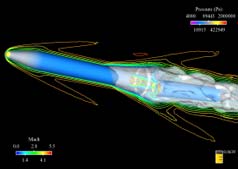 Loci (pronounced low-sigh, the plural of locus) is a C++ library and declarative programming framework that efficiently maps numerical algorithms onto parallel architectures. The approach is logic-based so that it allows a description of what the code should accomplish, but it does not dictate how to accomplish it (as in imperative programming). Loci is thus a flexible, rule-based programming model for numerical simulation that allows run time scheduling of the appropriate subroutine calls required to obtain a user specified goal, such as a CFD solution.
The front-end first generates a fact database from the rules, then generates the query (e.g., what is the flow solution?), and finally assembles the rules into the application (CHEM) that simulates 3D flows of turbulent, chemically reacting mixtures of thermally perfect gases. The solution process is completely different from a traditional CFD approach! Loci handles the parallel scheduling, load balancing, dynamic memory management, and cache optimization. From a programming standpoint, therefore, it is quite straightforward to add new physical models and boundary conditions or to solve new problems just by changing the fact database, creating new rules or changing the query. These aspects of the Loci infrastructure make the CHEM code highly innovative and unique.
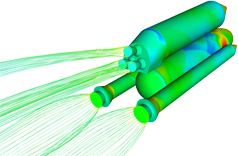 Tetra Research is a member of the Loci/CHEM development team that supports NASA and industry users of the code. We work closely with the creator of the Loci framework, Dr. Ed Luke of Mississippi State University, on numerous R&D projects to ensure that CHEM is able to solve the most challenging computational field simulations. We also offer specialized code development, validation and application support to achieve enhanced productivity with Loci/CHEM.
Loci/CHEM is currently in production use at NASA Marshall Space Flight Center. Selected examples of CHEM capabilities are located on this site and also on the web site maintained by Dr. Ed Luke. The technical development as well as further user applications are contained in the following subset of Loci/CHEM research papers:
- Tong, X., Luke, E.A., and Smith, R.E., Sensitivity Studies on Particle Emissions and Transport Around a Moving Vehicle, Proceedings of the 2011 Ground Vehicle Systems Engineering and Technology Symposium, Dearborn, MI.
- Morris, C. I. and Ruf, J. H., Validation of Supersonic Film Cooling Modeling for Liquid Rocket Nozzle Applications, AIAA 2010-6657.
- Hood, C. and Sims, J., Internal Flow Modeling of a Simulated Solid Propellant-Liner Debond Using Loci/CHEM, AIAA 2010-7164.
- Veluri, S. P., Code Verification and Numerical Accuracy Assessment for Finite Volume CFD Codes, Ph.D. Dissertation, Virginia Tech, August 2010.
- Veluri, S. P., Roy, C. J., and Luke, E. A., Comprehensive Code Verification for an Unstructured Finite Volume CFD Code, AIAA 2010-127.
- Roy, C. J., Tendean, E., Veluri, S. P., Rifki, R., Luke, E. A., and Hebert, S., Verification of RANS Turbulence Models in Loci/CHEM Using the Method of Manufactured Solutions, AIAA 2007-4203.
- Mack, Y., Haftka, R., Segal, C., Queipo, N., and Shyy, W.,Computational Modeling and Sensitivity Evaluation of Liquid Rocket Injector Flow, AIAA 2007-5592.
- Westra, D., Lin, J., West, J., and Tucker, K., Use, Assessment, and Improvement of the Loci/CHEM CFD Code for Simulation of Combustion in a Single Element GO2/GH2 Injector and Chamber, TFAWS 2006.
- West, J., Westra, D., Lin, J., and Tucker, K., Accuracy Quantification of the Loci/CHEM Code for Chamber Wall Heat Fluxes in a GO2/GH2 Single Element Injector Model Problem, NASA/MSFC, 2006.
- Luke, E. A., Tong, X-L., Wu, J., Tang, L., and Cinnella, P., CHEM: A Chemically Reacting Flow Solver for Generalized Grids, AIAA 2003.
additional Loci/CHEM Publications
Principal Loci/CHEM developer Dr. Ed Luke’s publications provide additional insight into the Loci framework as it relates to the development of generalized computational field simulation codes, of which CHEM is one example. CHEM is an unusually robust yet accurate two phase, turbulent, chemically reacting flow solver that operates on arbitrary polyhedral meshes. It is being used extensively by NASA/MSFC and industry to solve challenging CFD problems. Add-on modules for real fluids equations of state (e.g., Redlich-Kwong and Peng-Robinson), Six DOF Body Motion, and solid rocket motor simulations have also been developed.